Foothill Senior Helps Rebuild Robotics Program, Wins International Titles, Inspires Leadership | Milestones
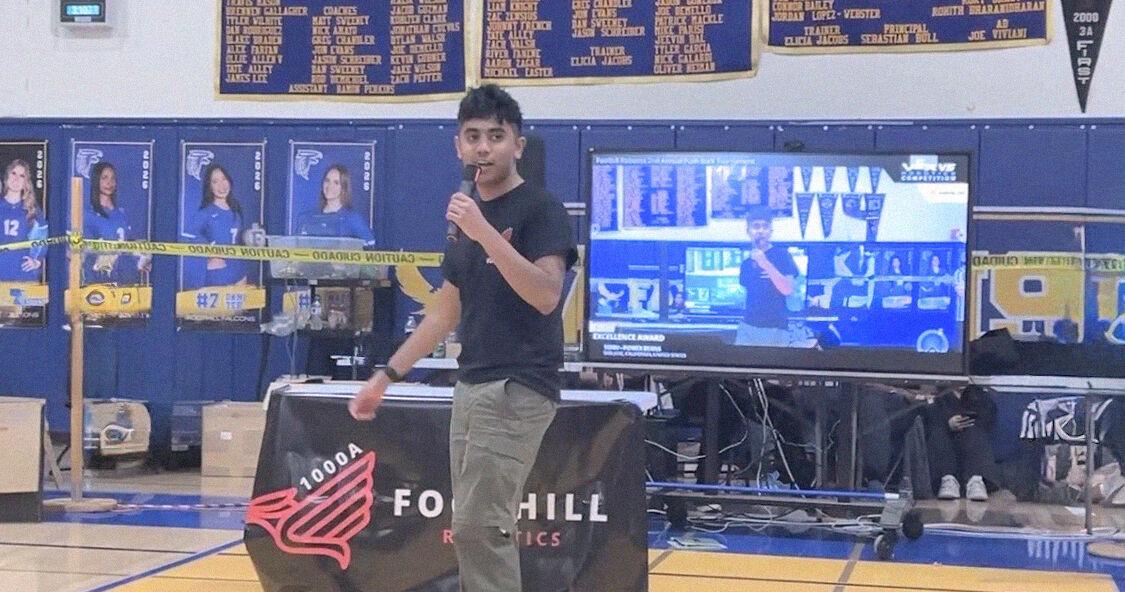
PLEASANTON — Foothill High School senior Neil Sarkar has loved building things since he was a kid — from radio-controlled airplanes to robotics — and that curiosity has helped power Foothill’s rise in competitive robotics in recent years.
Along with his peers, Sarkar led Foothill’s robotics team to three international championships: the Space City Signature Event, NorCal Signature Event and the VEX U.S. Open Red Division. The team also secured the Bay Area Championship and seven regional tournament wins.
VEX Robotics is an educational program that gives students hands-on experience designing, building and programming robots through yearly themed challenges.
Foothill competes in the annual VEX Robotics Competition, which introduces a new game each year. Matches are played in a two-on-two format on a 12-by-12-foot enclosed field, Sarkar said. Robots are designed to score points while disrupting opponents’ strategies.
“For the six years before, we hadn’t won a single award or even competed outside the Tri-Valley,” Sarkar told The Independent. He said he rebuilt the program “from a box of 12-year-old scraps,” regularly clocking more than 80 hours a week to build and prepare.
“I’ve always loved building things — from making RC airplanes to disassembling laptops at home,” he continued. “That love for creating drew me into robotics, where I could apply it to build something tangible.”
In 2024, Sarkar said Foothill became California’s highest-performing school, winning more tournaments than any other school in the state.
“Building even a single successful robot is impossible as a single person; it easily takes over 1,000 hours of work,” the senior said. “I love working with my team because we get so many different perspectives on the same problem just from working together.”
Sarkar’s leadership extends beyond competition. As president of Foothill’s robotics club, Sarkar said he founded three new teams and raised $16,000 to support their launch.
He also organized Foothill’s first robotics tournament, which he said was the only tournament in California that offered free entrance to all participating teams.
Sarkar also serves as president of Foothill’s Engineering Club, which coordinates tours with local engineering companies and supports four other STEM-focused clubs, he said.
Foothill High School engineering teacher Gary Johnson said Sarkar stands out for his initiative and the way he supports other students.
“Neil takes initiative in engineering; he sees new opportunities and goes for it,” Johnson said.
Johnson said Sarkar helped set up new machines in the engineering shop, learned how to maintain them and created resources for other students.
“He built, learned and maintains the machines, and also created a user manual and instructional videos for other students to reference,” Johnson said.
The senior said he took on that work because he remembered how long it took him to feel confident using the tools in the workshop.
As a freshman, he said he was unsure how to use the school’s large CNC machines — short for computer numerical control — and didn’t begin using them until later in high school.
“I wanted to help other students feel confident accessing the tools in our workshop sooner than I did,” he said.
Beyond the engineering shop, Sarkar also pursued research that blends psychology and technology.
Conversations with Foothill High psychology teacher Mary Rozelle inspired him to reach out to a UC Berkeley professor and explore research connecting human behavior with engineering.
His work focused on developing a small electronic device capable of unobtrusively measuring cognitive reaction times during natural conversation.
Reaction time is a well-established indicator of neurological health in cognitive psychology, and the student said continuous, passive measurement could offer a path toward earlier detection of health issues. His research was recently published in IEEE Access.
“I was especially driven by how simple engineering solutions could broaden access to medical care,” he said.
Johnson said Sarkar is leaving a lasting impact on the program.
“Neil embodies everything we like to see in students,” Johnson said. “Neil, whether he knows it or not, is establishing a legacy that will hopefully continue to grow and prosper beyond his time at Foothill.
He will be leaving the robotics team and the engineering shop significantly better off than when he arrived.”
Looking ahead, Sarkar said he has applied to colleges and hopes to major in electrical engineering, with plans to continue research in accessible medical instrumentation.
“I love how I’m able to apply my passion for engineering to directly help people,” he said.
“My main goal has always been making sure they (the programs) live on after I graduate,” Sarkar said. “I strive to share the skills I’ve learned so our school can continue to perform at a high level even after we graduate.”
link