


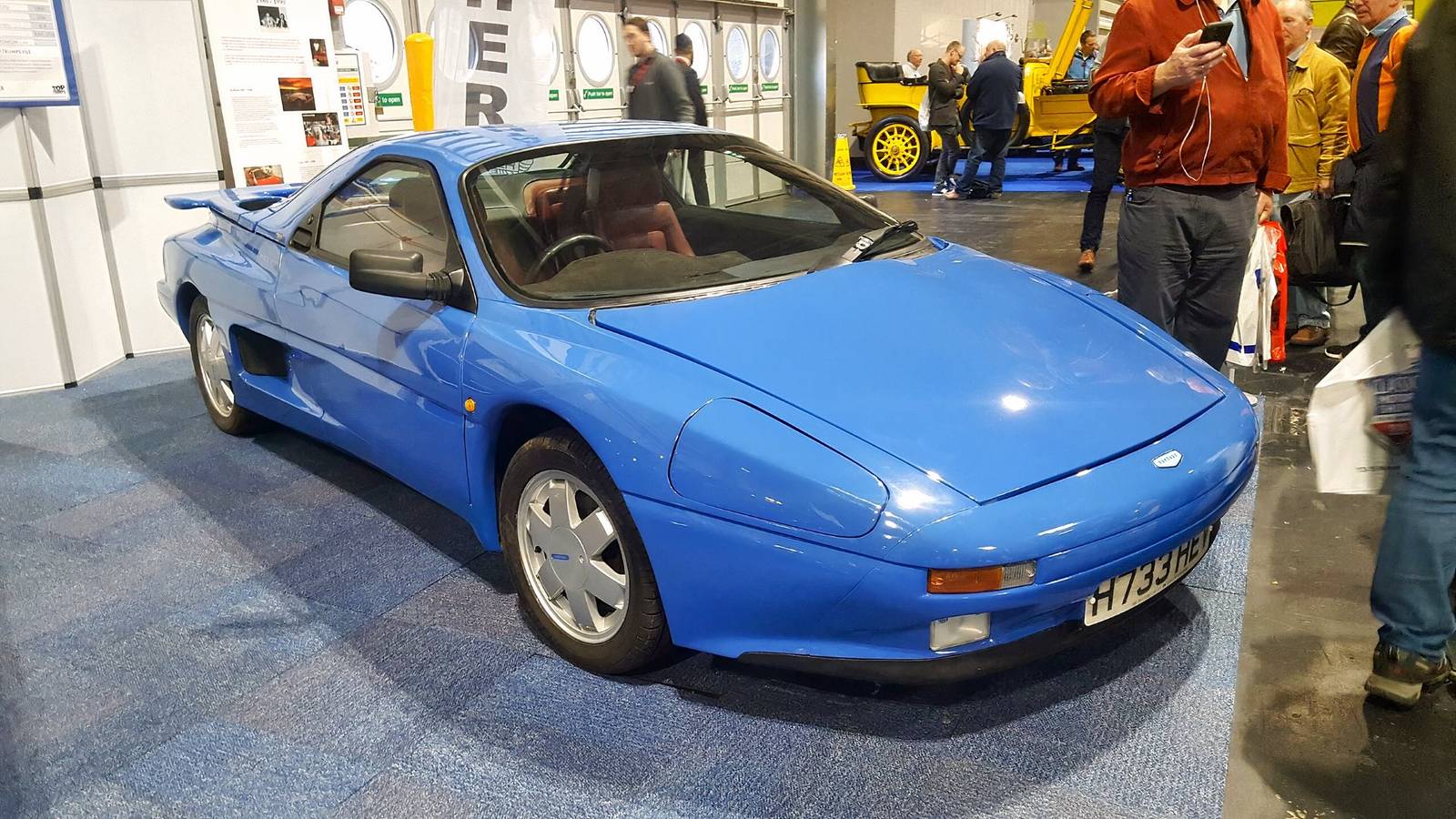
These days, mid-engined supercars with all-wheel drive are commonplace. Take something like the Bugatti Chiron. With an 8.0-liter W16 and 1,500 horsepower, sending power to all four wheels makes a lot of sense. Then there are the likes of the Audi R8 and Lamborghini Gallardo, the Bugatti EB110, the Porsche 918 Spyder – the list goes on.
But before all of these high-end machines, a small British firm was developing a mini-supercar that uses four-wheel-drive and a mid-engined layout. The model launched in 1990 and claims to be the first-ever sports car to use this layout, starting a trend that we all take for granted these days. However, this is a model that is sadly forgotten, with only a tiny number built and hardly any left on the roads. It was an ambitious project that was ahead of its time, for sure. To quote the great philosopher Marty McFly from Back To The Future: “I guess you guys aren’t ready for that yet. But your kids are gonna love it.”

The Panther Solo Is A Mid-Engined Four-Wheel-Drive Mini Supercar From The ’80s


The Panther Solo 2 may have come from a boutique manufacturer, but it was a pioneering car. For starters, it was well screwed together, with innovative features such as swiveling front lights and electrostatically lit dials. The bodywork itself was strengthened with a Kevlar/carbon composite, and carbon fiber was used for the upper door frames. The center section was made up of an aluminum honeycomb sandwiched between two epoxy-resin skins. Elements such as the rear wing were attributed to March Engineering, and used thinking from Formula 1 and IndyCar.
The Solo 2 Was A Mid-Engined Sierra Cosworth Under Its Skin
Under the pretty skin was the engine out of a Sierra Cosworth, mated to a Ferguson four-wheel drive system modified to use Ford Sierra XR4x4 components, and a Borg Warner T5 five-speed gearbox. There were standard anti-lock brakes to help scrub off the speed of the Cosworth 201-horsepower 16-valve four. The car also featured a Panther design transfer box with a viscous coupling limited-slip system. Torque was split 34% front and 66% rear, with front and rear differentials rubber-mounted, controlled by torque reaction arms. The $46,000 Panther Solo 2 had a curbweight of 2450 lbs and a top speed of 150 mph. Pretty decent for the ’80s.

Acceleration was expected to be extremely quick – Car and Driver claimed in 1988 that the car would hit 60 mph in just 5.7 seconds. This put it within 0.7 seconds of a Ferrari Testarossa, which cost twice as much ($94,000). What made the Solo extra special, however, was the combination of mid-engine and four-wheel-drive. No other manufacturers had thought of this, with turbos and all-wheel drive being a relatively new concept. The Ford RS200 had been sold in road trim, but this was a homologation special. Panther hoped to have a full series production car with the Solo 2.
The Panther Solo 2 Came About Because Of The Toyota MR2

The British Panther Westwinds Car Company was started by fashion designer Robert Jankel in 1972, apparently after getting the idea of joining the car business when a Spanish bullfighter offered to buy his Rolls-Royce for £10,000 ($13,500). The bravado and stage presence of the fashion industry were built into the DNA of Panther. There was the Panther Lima, a small roadster that was styled like a mix of a Morgan and a Bugatti Type 2. Perhaps, most notoriously, there was the Panther 6, an automotive version of Liberace, with six wheels and a V8 – the only thing missing was a candélabre.

It’s a strange beginning of what would become the svelte Panther Solo 2. The Solo had started life as a 1,870-lb featherweight mid-engined car, powered by a 104-horsepower Ford XR3i engine. The story goes that when the new MR2 arrived, another mid-engined car built by the mighty Toyota, the original Solo was stopped dead in its tracks. The car was then redesigned as the Solo 2, a more upmarket supercar. It seemed like a great proposition and used tried and tested Ford parts, which promised reliability. But it didn’t work out as well as hoped.
The Panther Solo 2 Stopped Before It Really Started
The early ’90s weren’t kind to sports car companies. The yuppie bonuses were drying up, the global economy was stalling, and even the big hitters were finding new ways to keep the lights on. The Panther Solo 2 was an incredibly advanced concept, but it also took a lot of time and money to build. It is estimated that $20 million went into the project, and each car was hand-built by a team of four engineers and trimmed in leather by one craftsperson.
It’s widely reported that each and every Panther Solo 2 needed hundreds of hours to complete, and then there were all sorts of time-consuming customization options on offer. Panther Car Club says that 16 Solos were built in total, with one being used for mandatory crash testing and another accidentally rolled at over 100 mph on a dual carriageway in the UK, with the occupants thankfully unhurt. Almost all Solos in the UK are thought to now be off the road.

The World’s Most Affordable Mid-Engine Sports Car You Can Buy For Under $9K
This cheap American sports car is slowly becoming a classic icon.
Buying A Panther Solo 2
The Solo 2 is a pioneering car that has sadly been forgotten. A lot of all-wheel-drive supercars today owe a little to the forward-thinking Solo, which was way ahead of its time. This was one of the smallest car companies in the world, but it was experimenting with innovations that other major manufacturers would take up more than a decade later.
So, if you want one, you’re out of luck, right? Wrong. There’s a Solo 2 for sale right now in the UK. The red 1990 example has 5,680 Miles on the clock and is offered at a price on application (POA). In 2012, a Solo also came up for sale, finished in Grey with a Bordeaux Red interior. This car had an auction estimate of just $16,000 to $20,300. In another 2017 auction, a 1992 Solo also sold for just $23,000. Not a lot for a slice of automotive history.
If you don’t want to roam the planet looking for an ultra-rare Panther Solo 2, you could also try a Toyota MR2, which offers the same thrills and big manufacturer oily bits, just with rear-wheel-drive instead of 4WD. The Toyota MR2 Mark 2 from 1992 will cost just $12,800 in good condition, according to Hagerty’s Valuation Tools, whereas a 200-horsepower MR2 Turbo from 1996 will set you back $26,500.
Sources: Hagerty, Panthercarclub.com; Carandclassic.com
link