



Whole lotta makin’ going on
Launched in 2015, the IDeATe program was designed to bridge the gap between technology and the arts, offering students a unique opportunity to explore the intersections of these fields. Over the past decade, IDeATe has grown to include a diverse array of minors and courses, ranging from game design and animation to sonic arts and intelligent environments.
Olivia Robinson, a teaching professor at CMU’s Entertainment Technology Center(opens in new window), has witnessed the significant growth of the IDeATe program since she founded CMU’s soft technologies minor and coordinated its creation in 2019.
“We’ve gone from eight sewing machines to 20, with another 15 we lend out. We now have a whole room just dedicated to dyeing fabric,” she said. “The growth of the program has been exponential. It’s a reflection of student interest.”
Among her faculty collaborations are a popular dye class(opens in new window) she co-teaches with chemistry professor Gloria Silva and a course taught by Melisa Orta Martinez(opens in new window), an assistant professor in the Robotics Institute(opens in new window), that uses weaving looms to teach advanced math.
“I’ve had a lot of good fortune in collaborations with other faculty and departments. I think it’s got something to do with the kinds of faculty Carnegie Mellon recruits,” she said.

Robinson teaches an inflatables class that gives students with no prior sewing or sculptural experience the opportunity to create large inflatable forms. The projects involve multidisciplinary teams and collaboration with sound and animation classes. The class had a significant impact on Maddie Burroughs, a senior in electrical and computer engineering(opens in new window) (ECE) who is pursuing minors in soft technologies and media design through IDeATe.
“I was able to develop strong sewing skills, which isn’t something I had done before,” Burroughs said. “For the final project, I was partnered with three other students, all in different colleges studying very different things. Working with our team gave me the opportunity to collaborate with others, applying my background to compliment theirs in a way I’m not able to do in my home department. In the end, we made a literally larger-than-life nature-themed inflatable that was showcased at WQED.”
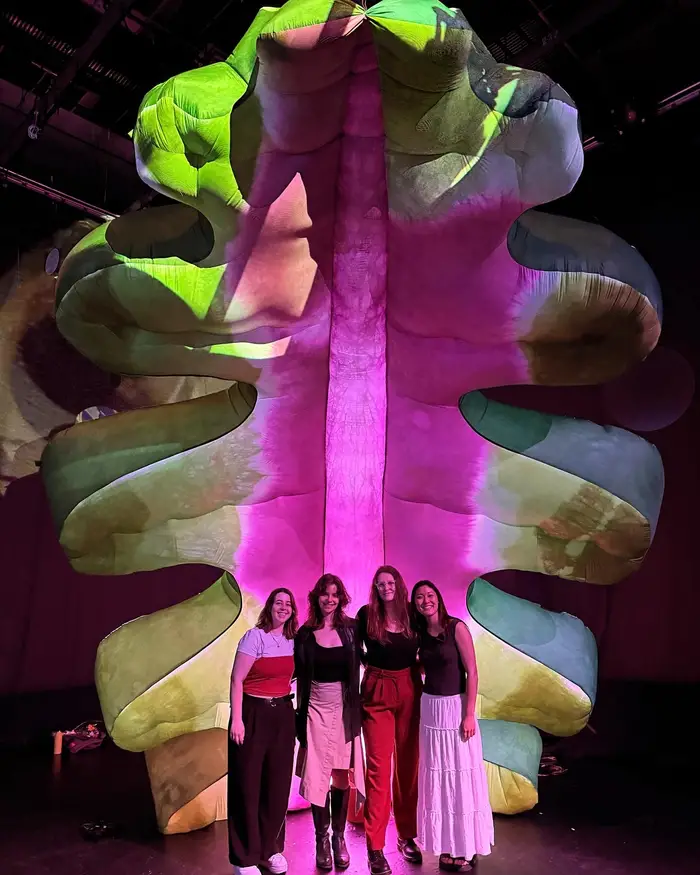

Burroughs said through the IDeATe program she’s been able to apply her primary major in more creative ways that interest her.
“Many of the instructors are artists and makers themselves, and the instructors I’ve been able to work with in IDeATe are some of the most invested and compassionate instructors I’ve ever worked with,” she said. “Our projects and assignments are often more flexible or self-defined than in other departments. The instructors really want to help you personalize project ideas based on what you’re interested in or want to learn.”
Robinson said some students even make radical changes in their career paths based on their experiences in IDeATe.
“Sarika Bajaj(opens in new window) was originally an ECE major. She started a company called Refiberd(opens in new window) focusing on recycling used textiles after her experience in IDeATe,” Robinson said.
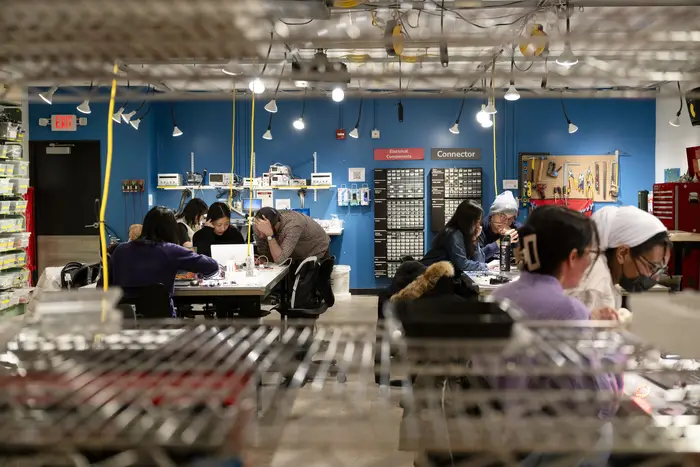

Zarmond Goodman, a film and visual media studies major, works in the fabrication lab as a senior tech adviser helping students safely operate the laser cutter. Having switched majors twice, Goodman is grateful to have had IDeATe as “an anchor,” “a common thread” and “a safe space” to stay grounded.
“I hope the next 10 years bring more visibility to IDeATe,” Goodman said. “The IDeATe community offers a real sense of belonging no matter what your background or experiences are.”
One memorable project Goodman recalled supervising was a scaled map of Pittsburgh with color-coded features, such as roads or bodies of water. Goodman helped the student translate the color codes to different laser strengths, so the laser would burn either darker or lighter. The map was also two scales, so they had to cut multiple pieces and put them together into one.
“It was really interesting to see the project physically exist in front of me after seeing it on the computer,” Goodman said. “That back-and-forth communication of trying to help someone who has a different skill set than you is also an invaluable skill to learn.”
Some of Goodman’s favorite projects to work on are the ones that students create in Robert Zacharias(opens in new window)’ physical computing class.
“Many of Robert’s students come into the fabrication lab with the coolest projects aimed at making life easier for people with disabilities,” they said. “I always love helping with those projects. That class is offered every semester, so I always get to interact with them and hear their stories about how people are helping other people, which is great.”
link